

In the power battery system of new energy vehicles, the battery shell accounts for about 20-30% of the total weight of the system, and is the main structural part of the battery. Lightweight and high safety make aluminum alloy battery pack casings the mainstream of power battery casings. The aluminum material used in power battery shell has the advantages of easy processing and forming, good high temperature corrosion resistance, good heat transfer and electrical conductivity. Therefore, the battery case with aluminum alloy is thinner and lighter than the steel case for the same capacity. In addition, once the battery explodes, the burst force of the aluminum case is also weaker than the steel case, and the harm caused by the aluminum shell power battery is relatively lower. At present, aluminum battery shells are mostly welded by laser.
01 Cutting
Cut the specimen with Beta-300Pro automatic cut-off machine;
Beta-300Pro automatic cut-off machine
|
Equipment |
Beta-300Pro automatic cut-off machine |
|
Consumables |
SiC cutting blade |
|
Parameter |
6a,0.6mm/s,2200rpm |
Hot mounting with TJ2231 epoxy resin;
MT-1H auto mounting
press
|
Equipment |
MT-1H auto mounting press |
|
Consumables |
TJ2231 |
|
Parameter |
180℃,120bar,5min, Medium-speed cooling |
03 Mounting- cold mounting
Cold mounting with TJ2210 acrylic resin;
ThetaMount cold press
TJ 2210 Acrylic resin
|
Equipment |
ThetaMount cold press |
|
Consumables |
TJ 2210 Acrylic resin |
|
Parameter |
0.3MPa,15min |
04 Grinding
Grind the specimen with GP-2000A automatic grinder&polisher, abrasive paper P400→P2500;
GP-2000A automatic
grinder&polisher
abrasive paper
|
Equipment |
GP-2000A automatic grinder&polisher |
|
Consumables |
Abrasive paper:P400;P800;P1200;P2000;P2500 |
|
Parameter |
Pressure: 0.3MPa, upper speed: 80rpm, lower speed: 150rpm, time: 2min |
05 Polishing - Rough Polishing
Use GP-2000A automatic grinder&polisher to polish the specimen, first use YS polishing cloth, with 3μm polycrystalline diamond suspension for rough polishing while adding polishing lubricant.
Y YS-JP white fiber polishing cloth
PD-W polycrystalline diamond suspension
|
Equipment |
GP-2000A automatic grinder&polisher |
|
Consumables |
YS polishing cloth,3μm polycrystalline diamond suspension,polishing lubricants |
|
Parameter |
Pressure: 0.3MPa, upper speed: 80rpm, lower speed: 150rpm, time: 2min |
06 Polishing-medium polishing
Use GP-2000A automatic grinder&polisher to polish the specimen, and then use ET polishing cloth with 0.05μm alumina suspension in medium polishing;
ET-JP white synthetic velvet polishing cloth
AO-P Alumina suspension
|
Equipment |
GP-2000A automatic grinder&polisher |
|
Consumables |
ET polishing cloth,0.05μm Alumina suspension |
|
Parameter |
Pressure: 0.3MPa, upper speed: 80rpm, lower speed: 150rpm, time: 2min |
07 Polishing - Fine polishing
Polishing the specimen with GP-2000A automatic grinder&polisher, then using ET polishing cloth with 0.05μm silicon dioxide suspension for fine polishing;
ET-JP white synthetic velvet polishing cloth
SO T401 silica suspension
|
Equipment |
GP-2000A automatic grinder&polisher |
|
Consumables |
ET polishing cloth,0.05μm silica suspension |
|
Parameter |
Pressure: 0.3MPa, upper speed: 80rpm, lower speed: 120rpm, time: 2min |
08 Observation
|
Equipment |
Leica DM2700M metallographic microscope |
|
Consumables |
|
|
Parameter |
50×→500×observation |
09 Analysis
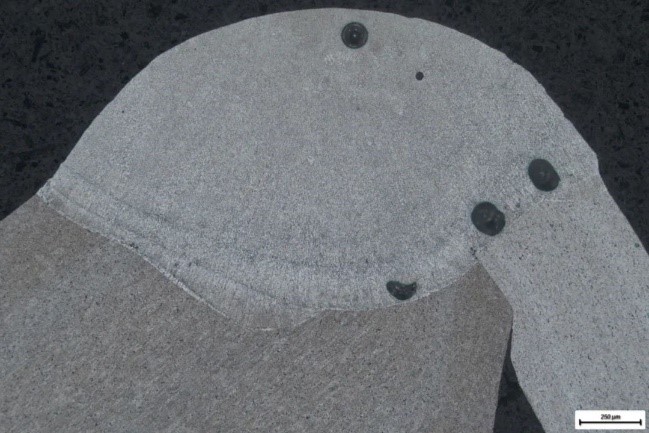
Right angle weld 50×
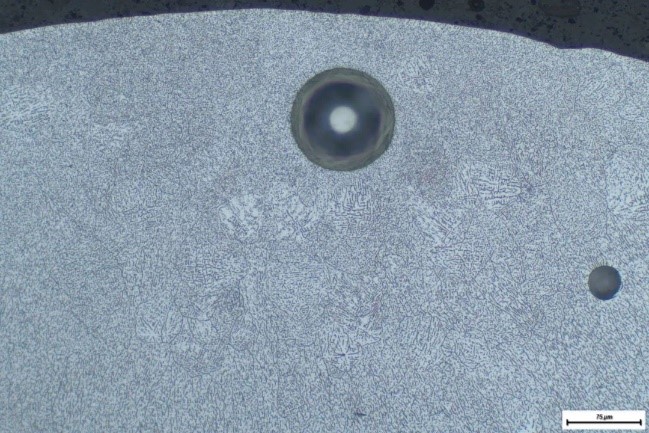
Right angle weld 200×
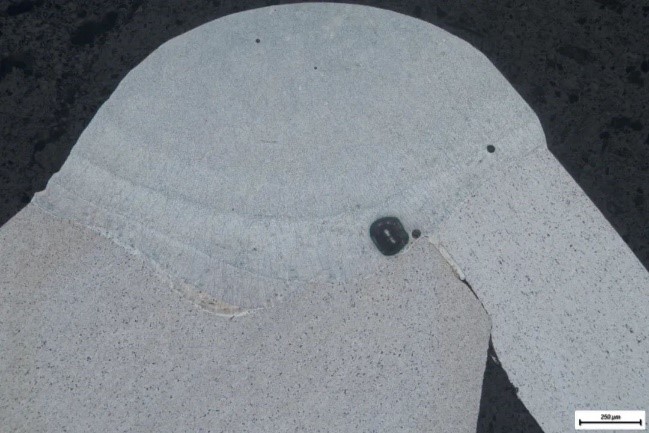
Fillet weld 50×
Fillet weld 200×
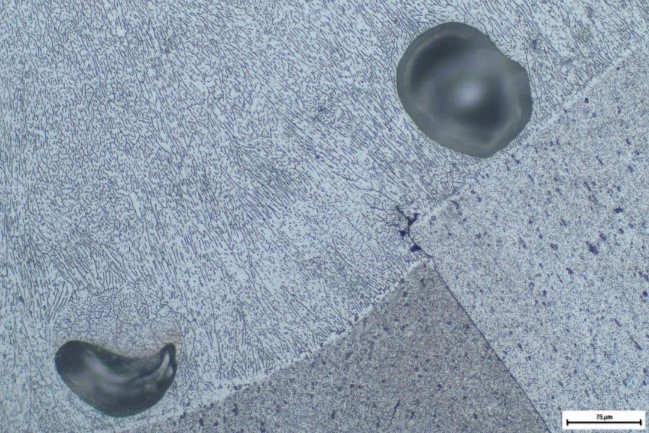
There are gaps in the fillet weld, so attention should be
paid to cleaning the sample during grinding and polishing to prevent the
leakage of the coarse particles contained and leave large scratches on the
surface of the sample.
The sample preparation results of cold mounting and hot mounting is the
same. Corrode the specimen with Keller's reagent.
Columnar crystals at the bottom of the laser weld pool, equiaxed grain in the core, lamellar segregation and holes are clearly visible.